
Chapter 3
What to Expect
1. The Reality Check
This page is about the process of learning English as a second language — especially when you already know some English, can communicate to some extent, and may feel that your English is “quite fine.”
At the beginning, many learners feel reasonably confident. They can understand a lot. They can complete exercises. They can manage familiar situations. They may even have used English at work or school for years.
Then comes the reality check.
During real speaking practice, correction, feedback, or transcript analysis, you may suddenly notice things you were not aware of before. You may notice that some sentences are literal translations from Polish. You may discover that structures you thought you “knew” are not yet available in spontaneous speech. You may realize that the message you intended to express is not always the message that actually came out.
This can feel uncomfortable.
For many learners, this moment causes a temporary drop in confidence. It may feel as if your English has suddenly become worse. In reality, your English has not become worse — your awareness has become sharper.
This stage is not a failure. It is the beginning of real improvement. You are no longer only using English automatically. You are beginning to see how your English actually works.
2. Readjustment and Acceptance
After the first reality check, there is usually a period of readjustment.
You may need time to accept that knowing a rule, recognizing a structure, or completing an exercise correctly is not the same as being able to use that structure naturally while speaking.
This is where the learning process becomes more honest.
You begin to understand that mistakes are not proof that you “can’t speak English.” They are information. They show which patterns are still influenced by Polish, which structures need more practice, and which habits need to be rebuilt.
At this point, many learners make an important decision: instead of protecting the old image of their English, they choose to improve the real one.
This shift matters.
The question changes from:
“Why am I still making mistakes?”
to: “What pattern am I ready to rebuild now?”
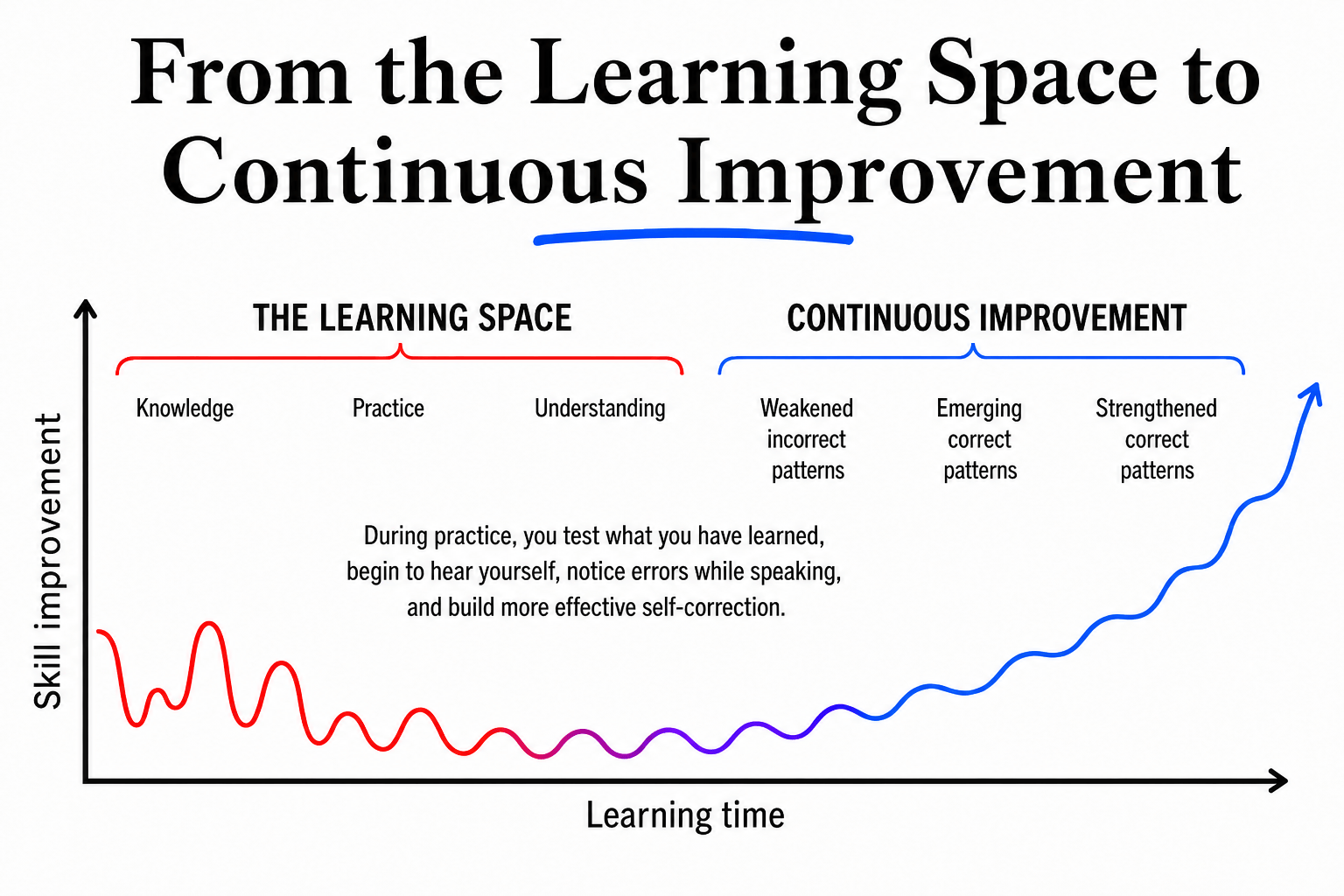
3. From Knowledge Through Practice to Understanding
For teenagers and adults, progress in a second language often begins with knowledge: you learn what a structure means, how it works, and why it is used.
Then it has to move into practice. You test it, repeat it, and begin to notice how it behaves in real speech.
Only then does it become a deeper understanding — not just a rule you remember, but a pattern you can gradually use.
This is why the early phase of learning can feel strange. You may be learning, practicing, and understanding more than before, but you may not yet feel fluent or stable. This does not mean that nothing is happening. It means the foundations of later progress are being built.
4. When English Starts to Feel Safer
Before speech becomes smoother, English often needs to feel less threatening.
You may notice small changes first. Your shoulders may not tighten quite so much when you speak. Your breathing may stay steadier. The panic spike may become weaker and shorter. You may be able to remain present in the conversation for longer.
As English begins to feel safer, you may have more mental space while speaking. It may become easier to remember words, recognize familiar phrases, and stay engaged in the conversation rather than mentally escaping into translation, pressure, or panic.
At this stage, English may begin to feel less chaotic. You may start recognizing phrases and chunks instead of assembling every sentence word by word. Some structures begin to sound familiar. You need less time to plan. You use more language from memory, rhythm, and repeated contact.
This is an important shift. English begins to feel less like a school subject and more like a system you can slowly move inside.
5. When Feedback Helps You Hear Yourself
With enough active practice and supportive feedback, another important stage begins: you start hearing yourself more accurately.
This stage is easy to underestimate. Many learners assume that the sentence they intended to say is the sentence that actually came out. In reality, speaking in a second language places significant demands on attention, memory, grammar, pronunciation, and emotional regulation simultaneously. When so much is happening at once, it is completely normal not to notice the difference between what you meant and what you actually said.
That is why external feedback matters. At the beginning, you may not hear the mistake while speaking. You may not notice it after the conversation either. You may only become aware of it when someone gently reflects it back to you, shows you the structure, or gives you the correct version to repeat.
Over time, this begins to change. First, you begin to recognize the difference when someone points it out. Later, you may notice it after speaking. Eventually, you may start hearing it while you are speaking and adjust in real time.
This is how self-correction becomes possible: not through pressure or shame, but through awareness, repetition, supportive feedback, and the gradual strengthening of new patterns.
6. When the Cycle Repeats
This process does not happen only once.
It often repeats when you encounter a new topic, a new grammar area, a more difficult conversation, or a situation that matters emotionally.
First, there may be another reality check. Then another moment of readjustment. Then acceptance. Then, the decision to improve the next layer.
The difference is that, over time, the emotional reaction usually becomes quicker and smoother.
You may still feel discomfort when you discover a new weak spot, but it no longer has to shake your confidence so deeply. You begin to recognize the process. You know that noticing a problem is not the same as failing. It is simply the next place where your English is ready to grow.
Later, progress becomes less about “finishing English” and more about continuous refinement. Every conversation, email, article, song, podcast, and meeting becomes another chance to adjust. You notice more. You recover faster. You correct yourself more naturally.
Progress becomes easier to feel and trust, but it is still not a final destination. You keep using English, noticing what happens, adjusting your patterns, and using the language again with slightly more accuracy, clarity, and confidence.
What Happens Next
In the next chapter, you’ll see how this process is supported in practice — through four areas of support that work with your body, mindset, inner story, and language patterns.